Skip to content

Upcoming concerts of “Backstage”

Ready to rock.

Ready to rock.

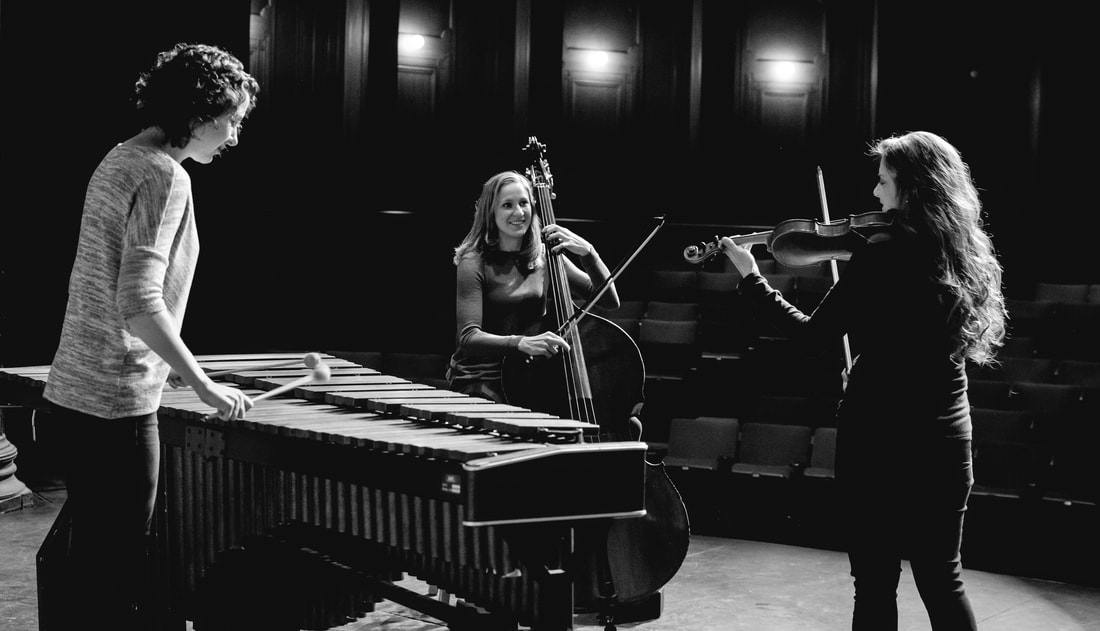
This year flutist Nicole Riner and I have been hard at work creating “Backstage: Stories and Music from the Practice Room to the Stage,” a show that weaves original narratives into chamber music selections to tell the tale of how chamber musicians work and create art. If you like the marimba, the flute, the sound of tiny wooden claves, or largely self-deprecating essays, we think you’ll like our new take on the traditional concert recital!

We premiered the show in Colorado and Wyoming (check out a review of the show), and now we’re bringing it for two dates in Boston. The more formal concert will be held at First Parish Cohasset, located at 23 N Main St. in Cohasset, MA.Admission is $15, or $12 for students and seniors.

We’re performing a free (and kid-friendly) version of the show at Creative Arts’ Open House on Saturday, March 16 from 1-3 p.m. This will be a much more casual production; we’ll perform the pieces and answer questions from the audience, as well as let students learn about our instruments. Creative Arts is housed in the First Congregational Church in Reading, on 25 Woburn St., and we’ll be performing in the chapel.


The good company we keep.

Great news for “The Audition” — it was named a finalist in the Feature Story category for the City & Regional Magazine Awards.

Even greater news: Patrick Doyle (also known as my husband) compiled a list linking to all the finalists’ articles. I’m already behind on work after reading this terrific profile of con man Mitchell Gross.

Baseball, golf, and the stage.

So close.

So close.

My greatest fear of performing is summed up by this passage from Chad Harbach’s The Art of Fielding: 

He hadn’t pushed through that one last barrier, his fear of succeeding, beyond which the world lay totally open to him. Schwartz would never live in a world so open. His would always be occluded by the fact that his understanding and his ambition outstripped his talent.

But then, recently, Dr. Bob Rotella’s Golf is Not a Game of Perfect finally had a retort that stuck:

People by and large become what they think about themselves.


This is my story.

The following was a presentation I gave at the University of Colorado-Boulder’s Entrepreneurship Center for Musicians. The students ate pizza and giggled as I told them my very silly path of finding my artistic voice. Thought I might share it with you, too: 

We could probably skip the next 20-30 minutes if I could show you the following comic and you and I both understood exactly what it meant in my life: http://www.incidentalcomics.com/2013/01/the-nature-of-ambition.html. 

drakemarchingI started walking an alligator in undergrad. I got dual degrees in journalism and music from Drake University, which is a small liberal arts college in Des Moines, Iowa. I went there because I loved writing, and I loved music, and they would let me get dual degrees, which I wanted for some reason. We also could afford it because I got scholarships , though some of those scholarships meant I had to play in the college marching band.

That’s the Drake University Marching Bulldogs. We didn’t have a name, actually, but the football team was called the Bulldogs, so I drew some conclusions. I played in the band for four years, and my most prolific moment was running out onto the 50-yard-line (while typing this I had to Google “football’s halfway line”) with a xylophone and playing the solo part to Santana and Matchbox 20′s “Smooth,” all while desperately realizing someone had put the accidental keys on incorrectly and that the F# was likely masquerading as a C#.

(Continued)

The process is a noble one.

CT george_saunders02.jpgGeorge Saunders, neatly unraveling all my work in arts entrepreneurship:

 Even for those thousands of young people who don’t get something out there, the process is still a noble one — the process of trying to say something, of working through craft issues and the worldview issues and the ego issues — all of this is character-building, and, God forbid, everything we do should have concrete career results. I’ve seen time and time again the way that the process of trying to say something dignifies and improves a person.

The Second Act

rockyI have been thinking a lot about second acts lately. Not the type of “second act” that has been coined recently, the idea of reinventing yourself mid-way through your life. I mean the storytelling second act, when you are in the hard times. The working times. Not a brief dip before a triumph, but a long, steady, hard, declining-beyond-what-you-can-imagine struggle.

I have been in a second act for about two years now. Second acts in a movie are the awkward part; the cringing moments when the couple has a misunderstanding that spirals down several levels and leaves them both staring out of windows or squinting uncomprehendingly off of balconies. It’s the part right before the triumphant Rocky training sequence, it’s when he’s getting treated for his limping plantar fasciitis. (Okay, that’s me again. Rocky’s strength would never allow for weak arches.) When you are living your life in the second act, it’s awkward for people to be around you because you are now embodying the least likable part of the story, the part that they fast-forward through.

(Continued)

The Orchestra App

I am getting my first iPad from Santa this Christmas, and I know the first app I’m going to download: The Orchestra.

This beautiful introduction to the orchestra stars the Philharmonia Orchestra. Not only can you watch them play the eight full selections included on the app — Haydn’s Symphony No. 6, Beethoven’s Symphony No. 5, Berlioz’s Symphonie Fantastique, Debussy’s Prelude to the Afternoon of a Faun, Mahler’s Symphony No. 6, Stravinsky’s The Firebird, Lutoslawski’s Concerto for Orchestra, and Salonen’s Violin Concerto — you can see the score scroll by, watch the different sections of the orchestra light up as their instruments sound, and listen to commentary by the players and conductor. Check out some screenshots here and a review here.

Frankly, it looks like a much more visually appealing version of what so many Music Appreciation textbooks have tried to do, and I can’t wait to try it out with my spring classes. What do you think about the choice of orchestra and the musical selections? Has anyone tried out the app yet?

Are you an amateur or a professional?

We all even dress the same.

Recently, I played two different orchestra concerts for free. This directly broke a promise I had made to myself as I worked desperately hard through my 20s to make a living as an artist. But trying to break into the clogged and difficult classical music market in Boston, I thought it would help me meet people.

I was surprised how much it affected me personally, playing for free. There was part of me that relished seeing people who owned restaurants and ran preschools picking up their old instruments and learning Debussy. But as I bought a $25 ticket for my husband to attend our performance, I felt conflicted. Just a month earlier, we had purchased $20 tickets for the Boston Symphony Orchestra. Later I asked him what differences he could hear between the groups. (He’s not classically trained, but he’s been dragged to quite a few concerts.) “I know one is better than the other,” he replied. “But by how much? Like, 5% better?”

(Continued)

Stop Saying Classical Music is Dead.

On November 16, Les Dreyer, a retired violinist with the Metropolitan Opera Orchestra, wrote a letter to the New York Times about his fear that classical music is doomed. His fear was triggered by a student asking him if Richard Wagner was a pitcher for the Yankees.  So Dreyer, horrified, ran down his list of reasons classical music is dying: Labor disputes, cancellations of tours, limited classical music on the radio, and an increased focus on rock and pop.

The Times framed his letter as an invitation for a Sunday Dialogue, so people mailed in responses and the result was a half-page discussion in the Sunday paper under the heading “Is Classical Music Dying?”

I have read this headline so many times in my ten years of playing professionally that I don’t expect to read about classical music without reading about its demise. If any article so much as mentions say, a violin, writers seem contractually obligated to detour away from a description of the music to lament the folly of pursuing a classical degree in this day and age. It’s distracting, continuing to build a career on something that all my writing colleagues insist on calling a corpse. I think it’s time to finally realize that it’s not classical music that’s the problem — it’s the way we talk about it.

(Continued)

The Audition: Your Reactions

My article about orchestra auditions has created a ton of discussion online, which is thrilling. I do believe that conversation leads to change, and the classical world needs a lot of that right now. A sampling of the reaction to “The Audition” is below:

A Musician and the Audition of His Life (from All Things Considered):

My reaction: This segment was thrilling to hear, because the producers really brought the article to life through music. I especially love hearing Mike’s comments about the Dvorak: “To play it feels as though you’re staring down a rival band across the square and trying to make your celebration more joyful than theirs. “ 

Cruel and Unusual: It’s Time to Change the Audition System:

And so, with this article as exhibit A, case study one million and one, I’m going to hop on my Vftp soap box and publicly call for an end to the system. It is a life-ruining, soul-destroying monstrosity. In any other field, it would qualify as torture. It is a dehumanising and damaging process that extracts an untellable toll in human suffering on musicians across the country. Far from being the perfect system for choosing an orchestra, I would say it’s closer to being the perfect system for driving people out of the field, for destroying their self-confidence and for absolutely eviscerating their love of music. 
 (And a great follow up from Kenneth Woods, after a ton of discussion on his site, titled “Consensus: How to reform orchestral auditions.”)

Orchestra auditions or Displaying a lifetime’s worth of dedication in the time it takes for a successful truck stop sexual encounter

The illusion that the system is “fair” is what props up the entire idea. Nothing underhanded could possibly happen because of this screen I stole from a tuberculosis hospital in 1896 and placed here to obstruct the view of the judges! 
Update: “The Audition” has also been linked on Byliner, The Browser, and Longform.  These are incredible websites that support writers, and I’m a lucky lady to be included. Update 2: “The Audition” has also been linked on Ladyjournos and The Feature. Thank you for sharing my story! Update 3: And Longreads! Hooray! Update 4: Thanks to NPR’s Deceptive Cadence for linking to the piece! Update 5: Big thanks to Kottke for the link.
After the jump, a sampling of the thousands of Tweets and Facebook posts — holy wow, y’all. Keep the conversation alive!